Generally speaking, the group of elements least likely to form ions are:
Group 1 - the alkali metals
Group 16 - the oxygen family
Group 17 - the halogens
Group 18 - the Noble gases
The most active metals are located in the:
lower right hand corner of the periodic table
lower left hand corner of the periodic table
upper right hand corner of the periodic table
upper left hand corner of the periodic table
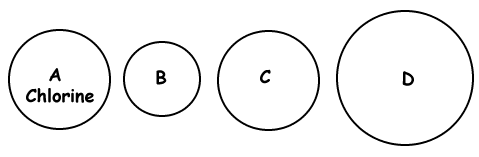
Given the representation of a chlorine atom, which circle might represent an atom of fluorine?
None of these
Circle B
Circle C
Circle D
Given the representation of a chlorine atom, which circle might represent an atom of bromine?
None of these
Circle B
Circle C
Circle D
Given the representation of a chlorine atom, which circle might a chloride ion, Cl-?
None of these
Circle B
Circle C
Circle D
Cations have a ______________ charge and are ______________ than the atoms from which they formed.
positive/larger
positive/smaller
negative/larger
negative/smaller
Anions have a ______________ charge and are ______________ than the atoms from which they formed.
positive/larger
positive/smaller
negative/larger
negative/smaller
As one moves down ( ↓ ) a group on the periodic table, the atomic radius of the elements encountered:
increases
decreases
stays the same
Of the following elements, which one would have the largest radius?
Hydrogen (H, atomic #1)
Sodium (Na, atomic #11)
Potassium (K, atomic #19)
Cesium (Cs, atomic #55)
Of the following elements, which one would have the smallest radius?
Fluorine (F, atomic #9)
Chlorine (Cl, atomic #17)
Bromine (Br, atomic #35)
Iodine (I, atomic #53)
Which of the following sets of elements could replace the generic "X" symbol with their own to produce a valid dot notation for the element(s)?
boron, aluminum and gallium
carbon, silicon and germanium
nitrogen, phosphorus and arsenic
oxygen, sulfur and selenium
Which of the following sets of elements could replace the generic "X" symbol with their own to produce a valid dot notation for the element(s)?
boron, aluminum and gallium
carbon, silicon and germanium
nitrogen, phosphorus and arsenic
oxygen, sulfur and selenium
Which of the following is the correct dot notation for the element carbon?
Which of the following is the correct dot notation for the element potassium, K?
Which of the following is the correct dot notation for the element sulfur?
Which of the following sets of elements could replace the generic "X" symbol with their own to produce a valid dot notation for the element(s)?
Identify the charge carried by a chloride ion.
1-
2-
3-
1+
2+
3+
Identify the charge carried by an oxide ion.
1-
2-
3-
1+
2+
3+
Identify the charge carried by a phosphide ion.
1-
2-
3-
1+
2+
3+
Identify the charge carried by a magnesium ion.
1-
2-
3-
1+
2+
3+
Identify the charge carried by an aluminum ion.
1-
2-
3-
1+
2+
3+
Identify the charge carried by a potassium ion.
1-
2-
3-
1+
2+
3+
What is the electron configuration of a sodium ion?
1s22s22p6
1s22s22p63s1
1s22s22p63s2
1s22s22p63s23p6
What is the electron configuration of a sulfide ion?
1s22s22p6
1s22s22p63s23p4
1s22s22p63s23p2
1s22s22p63s23p6
What is the electron configuration of a calcium ion?
1s22s22p63s23p4
1s22s22p63s23p64s23d2
1s22s22p63s23p64s2
1s22s22p63s23p6
When elements gain or lose electrons to form ions,
their nuclei become more stable
they have the electron configuration of a noble gas
they become noble gases
they become unstable
When forming ions, metals can be expected to _________ electrons while nonmetals can be expected to __________ gain electrons.
lose / gain
gain / lose
split / destroy
acquire / disperse
Ionic compounds are ordinarily found as
liquids
gases
plasma
crystals
Ionic compounds are held together by
electrostatic forces - opposites attract.
nuclear forces that overcome the repulsion of similar charges.
gravitational forces, since the ions are not the same size.
unknown forces - no one is certain what holds ionic compounds together.
Which of the following is the correct ionic compound formula for calcium sulfide?
CaS
Ca2S
CaS2
Ca3S2
Which of the following is the correct ionic compound formula for iron(III) oxide?
FeO
Fe2O
Fe3O2
Fe2O3
Which of the following is the correct ionic compound formula for sodium iodide?
NaI
Na2I
Na3I2
Na3I
Which of the following is the correct ionic compound formula for copper(II) fluoride?
CuF2
Cu2F
Cu2F2
Cu2F3
Which of the following is the correct ionic compound formula for barium nitride?
BaN2
Ba2N
Ba2N3
Ba3N2
Pretend that a new alkaline earth metal, with an atomic number of 120 is produced. It would initially be given the symbol Ubn (Un-Bi-Nilium, or 1-2-0-ium). If you could react this new atom with the already synthesized halogen, Uus (Ununseptium, 117), what would be the formula of the ionic compound that they would form? (By the way, 117 is too unstable and would decay in a less than a millisecond. The same would likely be true of 120, so you could never actually test this out!)
UbnUus2
Ubn2Uus3
Ubn2Uus
UbnUus
What is the formula mass of calcium oxide, CaO, rounded to the ones place?
56 grams
72 grams
48 grams
28 grams
What is the formula mass of sodium nitride, Na3N, rounded to the ones place?
83 grams
69 grams
40 grams
37 grams
What is the formula mass of chromium(III) fluoride, CrF3, rounded to the ones place?
109 grams
71 grams
51 grams
81 grams
Which of the following pairs of elements would not react to form an IONIC compound?
iron and oxygen
sulfur and phosphorus
sodium and iodine
aluminum and bromine
Which of the following pairs of elements COULD react to form an ionic compound?
potassium and calcium
fluorine and copper
sulfur and oxygen
hydrogen and oxygen
When electrons are exchanged between metals and nonmetals, metals ________ electrons to form ____________. Nonmetals ___________ electrons to form _____________.