In a solution of sugar and water, the solvent is the:
sugar
water
In a solution of sugar and water, the solute is the:
sugar
water
A substance whose water solution does not conduct an electric current is a(n):
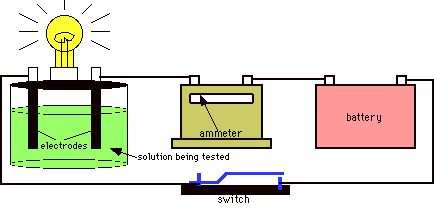
Which of the following substances, when dissolved in a water solution, will allow current to flow in the device pictured above, resulting in the lightbulb becoming lit?
Gases dissolve best in liquids when:
the pressure is high and the temperature is high
the pressure is low and the temperature is high
the pressure is high and the temperature is low
the pressure is low and the temperature is low
The solubility of potassium nitrate in water at 35 °C is about 60 grams KNO3 per 100 grams of water. How many grams of KNO3 should dissolve in 300 grams of water at 35 °C?
180 grams
20 grams
335 grams
Breaking up a solid speeds dissolving in a liquid by:
raising the temperature
decreasing the pressure
increasing surface area
slowing hydration
Most salts become more soluble in water as the:
pressure is increased
pressure is decreased
temperature is increased
temperature is decreased
Fats do not dissolve in water because:
Fats and water are both nonpolar
Fats are polar and water is nonpolar
Fats and water are both polar
Fats are nonpolar and water is polar
Calculate the concentration of the following solution in units of grams per liter:
12 grams of NaCl is dissolved in 3.00 L of solution
36 g/L
0.250 g/L
4 g/L
15 g/L
Calculate the concentration of the following solution in units of molarity, M, moles per liter:
80 grams of NaOH is dissolved in 2 L of solution
1 M NaOH
40 M NaOH
160 M NaOH
82 M NaOH
Calculate the concentration of the following solution in units of parts per million, ppm:
12 grams of NaCl is dissolved in 3.00 L of solution
4000 ppm NaCl
.004 ppm NaCl
4 ppm NaCl
4 x 10⁶ ppm NaCl
Calculate the concentration of the following solution in units of percent composition:
12 grams of NaCl is dissolved in 3.00 L of solution
40% NaCl
0.0068% NaCl
0.4% NaCl
25% NaCl
What two substances are always produced by a neutralization reaction?
an acid and a base
water and a base
water and a salt
water and an acid
According to the Brønsted-Lowry definition, a base is:
a proton (hydrogen ion) donor
a proton (hydrogen ion) acceptor
a proton (hydrogen ion)
a proton (hydrogen ion) destroyer
Acids taste:
Sweet
Salty
Bitter
Sour
Bases taste:
Sweet
Salty
Bitter
Sour
A positive test for an acid occurs when:
red litmus turns blue
red litmus remains red
blue litmus turns red
blue litmus remains red
A positive test for a base occurs when:
red litmus turns blue
red litmus remains red
blue litmus turns red
blue litmus remains red
Bases cause phenolphthalein to turn:
orange
green
violet
clear
Strong acids:
Ionize slightly and produce few hydrogen ions in solution
Ionize completely and produce many hydroxide ions in solution
Ionize completely and produce many hydrogen ions in solution
Ionize slightly and produce few hydroxide ions in solution
Indicator
Results
Phenolphthalein
Clear
Red litmus
Remains red
Blue litmus
Turns red
Methyl orange
Turns deep red
An unknown substance produced the experimental results noted above. Based on this data, the unknown is:
a base
a sugar
an acid
impossible to identify
The strongest bases are hydroxides of:
halogens
noble gases
transition metals
group 1 and group 2 metals
Which of the following is a property of acids?
Feel slippery
Turn red litmus blue
taste bitter
react with metals to form hydrogen gas
Acids have a pH that is:
greater than 7
equal to 7
less than 7
Bases have a pH that is:
greater than 7
equal to 7
less than 7
Which of the following pH values indicates the strongest acid?
1
4
7
11
When 100 mL of 1 M HCl is added to 100 mL of 2 M NaOH, the resulting solution would be:
acidic
basic
neutral
When 200 mL of 1 M HCl is added to 100 mL of 1 M NaOH, the resulting solution would be:
acidic
basic
neutral
When 100 mL of 1 M HCl is added to 100 mL of 1 M NaOH, the resulting solution would be:
acidic
basic
neutral
Carbon dioxide is produced when
acids neutralize bases
acids react with active metals
acids react with carbonate salts
bases dissolve in water
Which statement is true?
Acids are electrolytes. Bases are nonelectrolytes.
Acids are nonelectrolytes. Bases are electrolytes.
Acids and bases are electrolytes.
Acids and bases are nonelectrolytes.
At room conditions, the density of liquid water is about
1 g/mL
18 g/ml
22.4 g/mL
0 g/mL
The boiling point of pure water at standard pressure is
0°C
32°C
100°C
212°C
The freezing point of pure water at standard pressure is
0°C
32°C
100°C
212°C
Which of these phase changes occurs by the removal of energy?
Which of these phase changes occurs by the absorption of energy?
Separate 100 gram masses of iron and liquid water are each allowed to absorb 600 joules of energy. As a result,
the temperature of the water changes more than the temperature of the iron
the temperature of the iron changes more than the temperature of the water
the temperatures of both change by the same amount
neither the water nor the iron experience a temperature change
The temperature would be expected to remain constant during which of the following phase changes?
Use this information to answer the question below: ΔHfus (H2O) = 334 J/g ΔHvap (H2O) = 2260 J/g
How much energy is required to boil 50 grams of water at its boiling point?
100 J
113 000 J
45.2 J
50 J
Use this information to answer the question below: ΔHfus (H2O) = 334 J/g ΔHvap (H2O) = 2260 J/g
How much energy is required to melt 50 grams of ice at its melting point?
16 700 J
113 000 J
6.68 J
50 J
Which of these has the greatest density, assuming standard pressure?
Liquid water at 4°C
Liquid water at 95°C
Ice at -10°C
Steam at 120°C
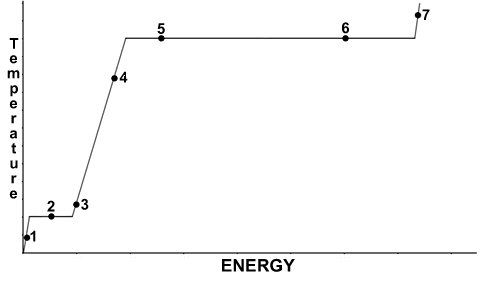
Refer to the image below when answering this question. Assume standard pressure. As energy is added and one moves from point #5 to point #6, the change taking place is
an increase in the temperature of liquid water
an increase in the density of water
liquid water is becoming steam
ice is melting
Refer to the image below when answering this question. Assume standard pressure. As energy is added and one moves from point #5 to point #6, the temperature
remains constant
increases
decreases
Refer to the image below when answering this question. Assume standard pressure. The temperature at point #6 is
100°C
32°C
0°C
100°F
Refer to the image below when answering this question. Assume standard pressure. At point #2, water would be found as
a liquid only
a solid only
a solid and a liquid
a liquid and a vapor
a vapor only
Refer to the image below when answering this question. Assume standard pressure. As energy is being removed (going right to left), the phase change occuring at point #2 would be
freezing
boiling
condensation
melting
Refer to the image below when answering this question. Assume standard pressure. The temperature at point #1 is
below 0°C
0°C
Between 0°C and 100°C
above 100°C
Refer to the image below when answering this question. Assume standard pressure. The density of water is highest at point
1
2
3
4
5
6
7
Refer to the image below when answering this question. Assume standard pressure. The measure of the energy required to move from point #3 to point #4 on the graph is determined by the
specific heat of liquid water
specific heat of steam
specific heat of ice
heat of fusion of water
heat of vaporization of water
Refer to the image below when answering this question. Assume standard pressure. Which forms of water would be present at point #7?
liquid only
steam only
ice only
liquid and steam
solid and liquid
Refer to the image below when answering this question. Assume standard pressure. The difference in temperature between point #2 and point #6 is
100°C
273°C
32°F
212°F
Refer to the image below when answering this question. Assume standard pressure. Features of this graph support which observations about water?
Which of these is NOT a characteristic of most pure substances, but is true of water?