On the Kelvin scale, a temperature of 22 degrees celsius has a value of:
-251 kelvins
295 kelvins
782 kelvins
273 Kelvins
Convert 300 °C to Kelvins
300 °C = 27 K
300 °C = 573 K
300 °C = -27 K
300 °C = 1060 K
Convert 100 K to °C
100 K = 373 °C
100 K = -173 °C
100 K = 473 °C
100 K = 173 °C
Convert 120 K to ºC
393 °C
-153 °C
493 °C
153 °C
Standard Pressure is equal to
Which pairs represent Standard Temperature and Pressure (STP)?
At standard pressure, a sample of nitrogen occupies 500 mL. What volume does the gas occupy when the pressure doubles?
1000 mL
250 mL
5.0 mL
20 mL
At a pressure of 5.0 atmospheres, a sample of gas occupies 40. liters. What volume will the same sample occupy at 1.0 atmosphere.
8.0 liters
200 L
5.0 L
20 L
At constant pressure and 25 °C a sample of gas occupies 4.5 liters. At what temperature will the gas occupy 9.0 liters?
50 °C
596 °C
596 K
50 K
A small sample of helium gas occupies 6 mL at a temperature of 250 K. At what temperature does the volume expand to 9 mL?
125 K
167 K
375 K
50 K
In a closed container at 1.0 atmosphere, the temperature of a sample of gas is raised from 300 K to 400 K. What will be the final pressure of the gas?
1.3 atmospheres
100 atmospheres
0.010 atmospheres
0 atmospheres
A sealed, inflexible container of oxygen gas has a volume of 2 liters. When the temperature of the gas is 300 K, the pressure in the container is 110 kPa. At what temperature will the pressure be cut in half?
150 K
600 K
450 K
200 K
A helium filled balloon has a volume of 4.0 L at 275 K and 800 mm Hg. What volume does the gas occupy at 550 K and 400 mm Hg?
16 L
8 L
1 liter
2 L
When a supply of hydrogen gas is held in a 4 liter container at 320 K it exerts a pressure of 800 torr. The supply is moved to a 2 liter container, and cooled to 160 K. What is the new pressure of the confined gas?
800 torr
400 torr
200 torr
1600 torr
As the volume of a confined gas decreases at constant temperature, the pressure exerted by the gas:
increases
decreases
stays the same
As the temperature of a confined gas increases, the pressure:
increases
decreases
stays the same
fluctuates
Organize the following gases in order of their rates of difusion, from fastest to slowest:
oxygen, O2
ammonia, NH3
hydrogen, H2
carbon dioxide, CO2
hydrogen, ammonia, oxygen, carbon dioxide
ammonia, hydrogen, oxygen, carbon dioxide
carbon dioxide, oxygen, ammonia, hydrogen
oxygen, carbon dioxide, hydrogen, ammonia
carbon dioxide, oxygen, ammonia, hydrogen
A sample of hydrogen gas is held in a one liter metal cylinder. At what temperature will the gas exert the greatest pressure?
25 ºC
35 ºC
40 ºC
55 ºC
At which of the following temperatures will a gas diffuse through a room most rapidly?
0 ºC
35 ºC
40 ºC
55 ºC
One mole of molecules is held in each of the following containers at identical temperature. In which container will the pressure be lowest?
1 liter jar
10 liter jar
22.4 liter jar
50 liter jar
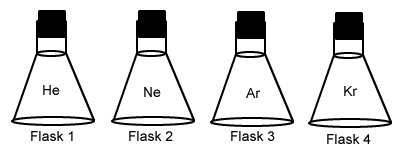
At a temperature of 25 degrees celsius and a pressure of 1 atmosphere, which of the following molecules will have the highest average speed?
He
Ne
Ar
Kr
Which of the following gases would have the fastest rate of diffusion, assuming all of the gases are at the same temperature?
He
Ne
Ar
Kr
Which of the following gases would have the slowest rate of diffusion, assuming all of the gases are at the same temperature?
He
Ne
Ar
Kr
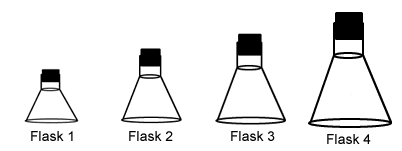
Each of these flasks contains the same number of gas molecules. In which would the pressure be highest?
Flask 1
Flask 2
Flask 3
Flask 4
Each of these flasks contains the same number of gas molecules. In which would the pressure be lowest?
Flask 1
Flask 2
Flask 3
Flask 4
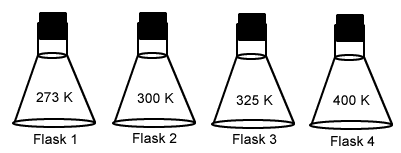
If all of the following flasks are the same size, at the same temperature, and contain the same number of molecules, in which flask will the pressure be highest?
Flask 1
Flask 2
Flask 3
Flask 4
All have the same pressure
If all of the following flasks are the same size, at the same temperature, and contain the same number of molecules, in which flask will the molecules be moving fastest?
Flask 1
Flask 2
Flask 3
Flask 4
If all of the following flasks are the same size, at the same temperature, and contain the same number of molecules, in which flask will the molecules be moving slowest?
Flask 1
Flask 2
Flask 3
Flask 4
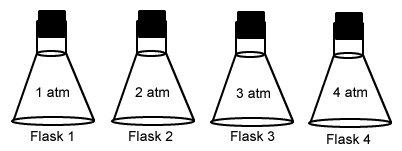
Each of these flasks is the same size and at the same temperature. Which one contains the most molecules?
Flask 1
Flask 2
Flask 3
Flask 4
Each of these flasks is the same size and at the same temperature. Which one contains the fewest molecules?
Flask 1
Flask 2
Flask 3
Flask 4
Each of these flasks is the same size and at the same temperature. In which flask will diffusion occur most slowly?
Flask 1
Flask 2
Flask 3
Flask 4
Four different flasks contain gas samples at 298 K. In which of the following samples will the gas molecules be moving the fastest?
H2
O2
N2
CO2
Which of the following changes to a system WILL NOT result in an increase in pressure?
Decreasing the volume of the container
Adding more gas molecules
Raising the temperature
Increasing the volume of the container
Each of these flasks contains the same number of molecules. In which container is the pressure highest?
Flask 1
Flask 2
Flask 3
Flask 4
Four different flasks contain gas samples at 298 K. In which of the following samples will the gas molecules be moving the slowest?
H2
O2
N2
CO2
Each of these flasks contains the same number of molecules. In which container is the pressure lowest?
Flask 1
Flask 2
Flask 3
Flask 4
What volume is occupied by one mole of a gas at STP?
22.4 L
760 L
1 L
273 L
What volume is occupied by 3 moles of nitrogen gas at STP?
7.46 L
67.2 L
3 L
30 L
If all of the following gases are at the same temperature and pressure, which gas has the greatest density?
Nitrogen, N2
Chlorine, Cl2
Methane, CH4
Oxygen, O2
Water can be decomposed by electrolysis to produce hydrogen and oxygen gases.
2 H2O → 2 H2 + O2
What volume of oxygen can be collected at STP from the decomposition of 1 mole of water?
5.6 L
11.2 L
22.4 L
44.8 L
Water can be decomposed by electrolysis to produce hydrogen and oxygen gases.
2 H2O → 2 H2 + O2
What volume of hydrogen can be collected at STP from the decomposition of 1 mole of water?
5.6 L
11.2 L
22.4 L
44.8 L
Water can be decomposed by electrolysis to produce hydrogen and oxygen gases.
2 H2O → 2 H2 + O2
What volume of hydrogen can be collected at STP from the decomposition of 36 grams of water?
5.6 L
11.2 L
22.4 L
44.8 L
Water can be decomposed by electrolysis to produce hydrogen and oxygen gases.
2 H2O → 2 H2 + O2
What volume of oxygen can be collected at STP from the decomposition of 36 grams of water?